Solar panel installation cost and payback period in Malaysia
By Adam · Updated 2026-06-19
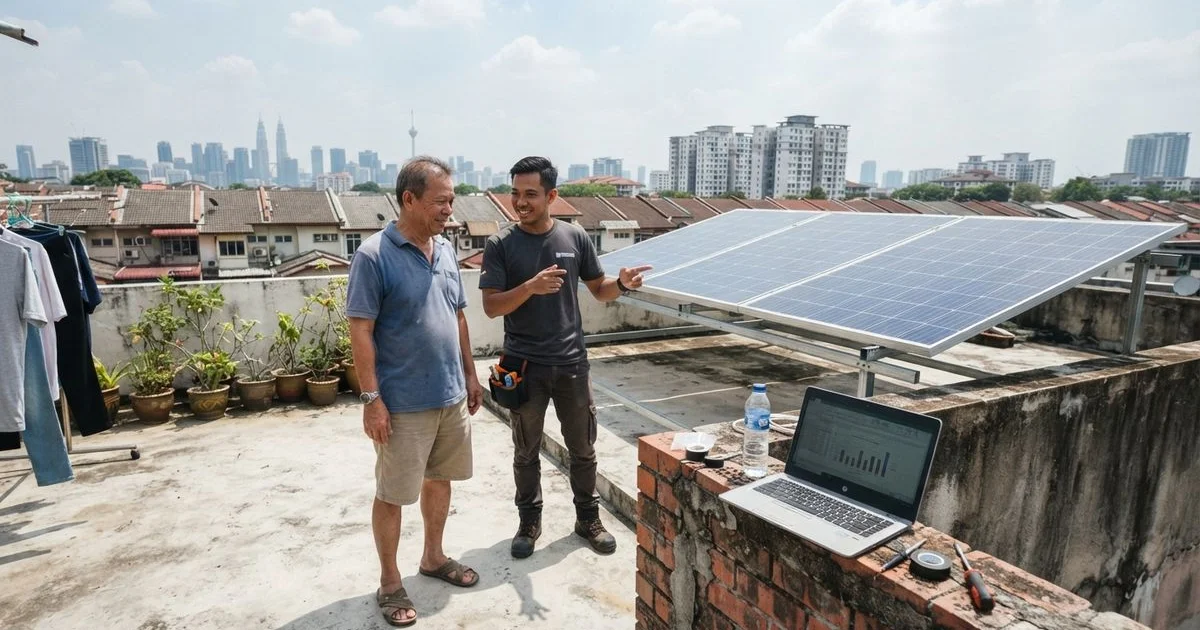
Solar is one of the few electrical upgrades homeowners choose to make rather than being forced into by a fault or a renovation, which means the cost question usually comes with a second one attached: is it actually worth it. The honest answer depends more on your household’s usage pattern than on the size of the system alone.
You can compare solar panel installers once you have a rough sense of what size system fits your usage, but it helps to understand the cost and payback shape first.
What a residential system costs
Pricing for home solar systems in Malaysia tends to scale fairly predictably with system size, though panel brand, inverter quality, and roof complexity all move the number within each band.
| System size | Typical cost range | Suits |
|---|---|---|
| Small (around 3 to 4kW) | From around RM10,000 | Smaller households with modest daytime usage |
| Mid-size (around 5 to 7kW) | Mid-range, between the small and large bands | Average landed homes with regular daytime appliance use |
| Large (around 8 to 10kW) | RM30,000 or more | Larger homes, higher daytime usage, or homes planning to add EV charging |
These figures cover the panels, inverter, mounting, and installation labour. A proper quote should break each of these out separately rather than giving you one number, since panel brand and inverter quality both carry meaningfully different price points and warranty terms.
What actually drives the price within a size band
A few things move the cost beyond the raw kW figure. Panel brand and efficiency matter, since higher-efficiency panels cost more per watt but need less roof space for the same output. Inverter quality matters too, and it’s worth asking specifically what warranty covers the inverter versus the panels, since inverters are the component most likely to need attention over the system’s lifespan. Roof complexity, meaning shading, orientation, and how much structural reinforcement or waterproofing work is needed around mounting points, can also shift the labour cost more than people expect.
How payback actually works
Payback isn’t a fixed number of years that applies to every household. It depends on how much of your own daytime electricity usage the system offsets, since that’s the portion of your bill you stop paying for directly. A household that uses a lot of power during daylight hours (running aircon, appliances, and equipment while the sun is out) offsets more of its own generation than a household that’s mostly out during the day and uses power in the evening instead.
Under Malaysia’s Net Energy Metering (NEM) scheme, excess power your system generates can be exported to the grid for credit, which affects the payback calculation too, though the value of exported power is generally lower than the value of power you use directly instead of buying from TNB. A properly sized system, matched to your actual usage rather than the biggest one that fits your roof, tends to pay back faster than an oversized one that exports more than it needs to.
Sizing it to your actual usage
The most common mistake isn’t picking a bad installer, it’s picking a system size before knowing your usage pattern. Your average monthly bill is a reasonable starting point for a rough size estimate, but a good installer should do a proper site assessment, checking your roof’s orientation and shading, before finalising a recommendation. Be cautious of anyone who quotes a system size without seeing your roof or asking about your bill.
The paperwork that’s part of the cost
A system isn’t just physically installed and switched on. It needs TNB and SEDA approval under the NEM scheme before it’s legally grid-connected, and this paperwork is part of what a properly registered installer handles as part of the job, not an optional extra. Confirm before signing that TNB and SEDA submission is included in the quoted price, since an installer who leaves this out (or isn’t registered to handle it at all) can leave you with a system that’s installed but not actually approved to connect.
Getting quotes that are actually comparable
Because system size, panel brand, and inverter quality all move the price independently, get two or three itemised quotes rather than comparing headline numbers. Ask each installer to break down panel wattage, panel count, inverter capacity, and what warranty covers each component. A detailed quote that’s slightly higher is often a better deal than a vague one that’s lower, once you account for what’s actually included.
See our methodology for how we score installers on licensing and workmanship, and browse the full directory from the homepage to compare across every electrical category.
FAQ
- How much does a home solar system cost in Malaysia?
- Residential systems typically run from around RM10,000 for a small 3 to 4kW setup to RM30,000 or more for larger 8 to 10kW systems, depending on panel brand, inverter quality, and how complex your roof is to work with.
- What determines how fast a solar system pays for itself?
- Mainly how much of your own daytime electricity usage the system offsets, since that's the portion you stop paying TNB for directly. Your existing bill size, how much sun your roof gets, and how the system is sized against your actual usage all matter more than the sticker price alone.
- Do I need approval before installing solar panels?
- Yes. A grid-connected system needs to go through TNB and SEDA under Malaysia's Net Energy Metering scheme before it's legally connected. A properly registered installer handles this paperwork as part of the job.
- How long does installation take?
- The physical installation for a home system usually takes one to three days once materials are on site. The full process, including the site survey and TNB and SEDA approval, can take several weeks to a couple of months depending on how quickly paperwork clears.