No power at home: what to check before calling an emergency electrician
By Adam · Updated 2026-06-17
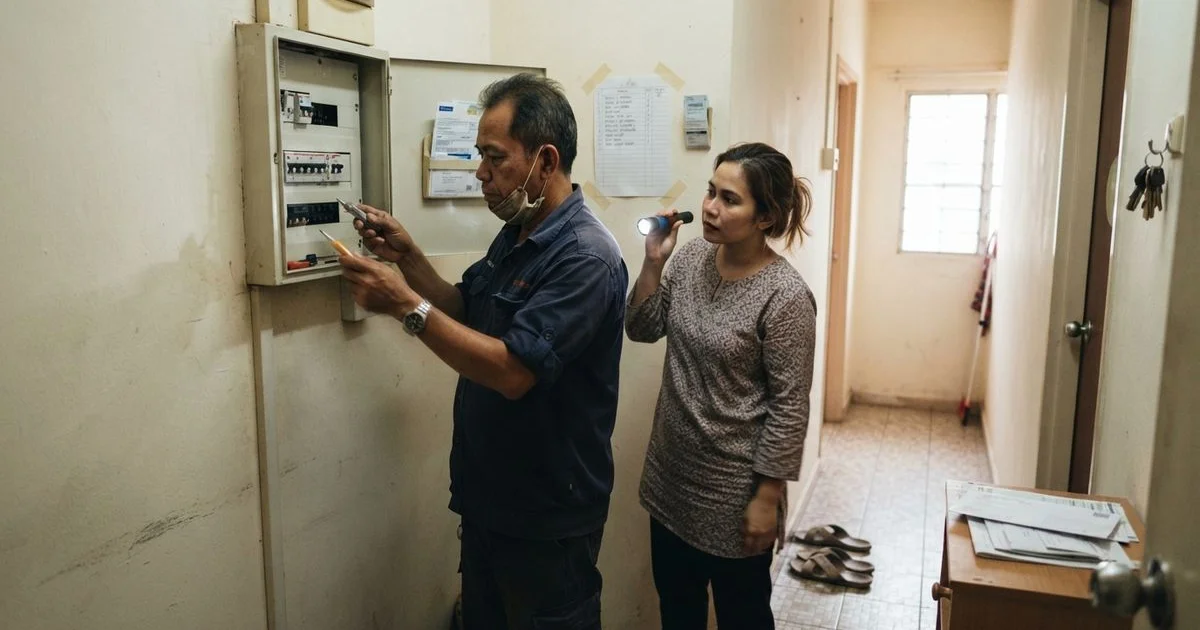
Losing power is disorienting, and the instinct is often to call someone straight away. A few quick checks first can save you an unnecessary call-out fee, or tell you clearly that this genuinely needs an urgent no-power callout right now rather than in the morning.
Step one: check if it’s just you
The fastest way to narrow down the cause is to check whether your neighbours have power. If the whole street, block, or building is dark, this is almost certainly a supply-side outage rather than a problem with your wiring, and calling an electrician won’t fix it any faster than waiting for the utility to restore supply. If you’re on a prepaid meter, it’s also worth checking your credit balance before assuming anything else is wrong.
Step two: check your consumer unit
If your neighbours have power and you don’t, go to your consumer unit (the distribution board, sometimes called the DB box or fuse box) and look for a tripped switch. A tripped main switch or a tripped RCCB (the earth leakage breaker) is one of the most common causes of a sudden, total loss of power inside a single unit.
| What you see | Likely cause | What to do |
|---|---|---|
| Main switch or RCCB flipped to off | A fault somewhere on the circuit, or an overloaded circuit | Try resetting once; if it trips again immediately, stop and call a professional |
| Only one circuit’s breaker tripped | A fault on that specific circuit (an appliance, a socket) | Unplug recently used appliances on that circuit, then try resetting |
| Nothing tripped, still no power | Possible supply issue, meter fault, or upstream wiring problem | Check with neighbours and, if it’s isolated to you, treat as a fault |
| Burning smell, visible sparks, or scorch marks | A genuine electrical fault | Do not touch it. Call an emergency electrician immediately |
| Water near the switchboard | Serious safety risk | Stay clear and call a professional right away, do not attempt to reset anything |
When resetting is fine, and when it isn’t
Trying a breaker once, after unplugging anything you were recently using on that circuit, is a reasonable first step. What isn’t reasonable is resetting it repeatedly when it keeps tripping. A breaker that won’t hold is doing its job by cutting power to protect the circuit from a real fault, and forcing it back on defeats the purpose. If it trips again within a minute or two of resetting, that’s your answer: something needs a proper look, not another reset.
What genuinely can’t wait
A handful of signs mean you should stop troubleshooting and call someone straight away: a burning smell anywhere near the switchboard or sockets, visible sparks, scorch marks, exposed wiring, or water anywhere near electrical fittings. None of these are safe to keep testing yourself, and they’re exactly the situations a 24-hour electrician exists for. On the other hand, a single dead socket, a light that’s stopped working in one room, or an outage that matches what your neighbours are also experiencing usually isn’t urgent and can wait for a normal appointment, which also tends to cost less.
What to have ready if you do call
If you’ve been through the checks above and it’s genuinely a fault on your side, having a few details ready speeds things up: whether the whole unit lost power or just part of it, whether you smelled anything before it happened, whether you’d recently done any DIY work or plugged in a new appliance, and whether resetting the breaker held or tripped again straight away. A good electrician will ask most of these questions anyway, but having the answers ready means less back and forth once they’re on site.
Running through this checklist takes a few minutes and either resolves the problem yourself or tells you clearly that it’s worth the call. Either way, you’re better off than guessing in the dark. You can see how we score responsiveness and pricing for emergency providers on our methodology page, and the homepage is a good starting point to compare electricians more broadly.
FAQ
- How do I know if it's a TNB outage and not my own wiring?
- Check whether your neighbours also have no power. If the whole street or block is affected, it's almost certainly a supply outage rather than a fault inside your home, and you can check TNB's outage information instead of calling an electrician.
- Is it safe to reset a tripped breaker myself?
- Resetting a breaker once is generally fine. If it trips again immediately, or trips repeatedly, stop and treat it as a fault rather than resetting it over and over, since that can be a sign of a genuine problem that needs a proper diagnosis.
- What should I never do myself when the power goes out?
- Don't touch a switchboard or wiring that's wet, don't attempt any repair near a burning smell or visible sparks, and don't keep resetting a breaker that won't hold. These are signs to call a professional, not troubleshoot further yourself.
- When is a power outage actually an emergency?
- Burning smells, sparks, exposed wiring, or a total loss of power with no outage affecting your neighbours are worth an urgent call. A single dead socket or a power cut that matches a known area-wide outage usually isn't.